Wednesday, 17 August 2011

Discovering Koraput...again!


Kamakhya Das writes in about his experience in Koraput, Orissa along with the Travel Another India team. Read on and get tantalized about this slice of 'another' India...   

I am sure most of you who are reading this piece would be hearing about Koraput for the first time. Having grown up in this hilly town and its beautiful greens, there’s something magnetic which brings me back to Koraput again and again. Everytime I visit Koraput it looks more beautiful and fresh. Having lived the fast paced life of Mumbai for almost a decade now, no one can feel the contrast more than me. The pace of life is distinctly different and sometimes it feels like two different worlds.

I visited Koraput early June this year and I deliberately did it like a tourist rather than someone who is very much a part of it. I will try to remain as unbiased in sharing my experience as I can be, however if you wish to validate what I am saying… you need to plan a trip.. and I can assure you that you will not be disappointed with what you will see and experience.

As you travel from Vishakhapatnam to Koraput, you can feel a distinct change in temperature. Once you hit Odisha border on your way from Vishakhapatnam to Koraput, you can see Deomali ranges of mountains along your way with beautiful greenery and landscape. The whole approach of looking at Koraput changed this time as I was travelling with Gouthami from Travel Another India, who with her loads of experience as a traveler made me look at things which I have been missing all these years.

Deomali ranges of mountains on my way from Vishakhapatnam to Koraput.

After resting overnight, I along with my brother, sister-in-law and Mr Sujay Pradhan who is a coffee estate owner and a close associate took Gouthami on a trail of a beautiful pine forest just two kilometers from Koraput. Apart from the serene environment with chirruping birds, the peace and tranquility was just overpowering, a real privilege when compared with the mad rush at Mumbai which is a part of my daily routine.

On a morning trail at the pine forest in Koraput.


A beautiful silver eucalyptus tree at with pine trees in the background at the pine forest in Koraput.

When early June is associated with mercury at its peak for most of India and rest of Odisha, the weather at Koraput as usual was a pleasure for me and a pleasant surprise for Gouthami. Without fail, it rained during the afternoon almost all the days we were in Koraput and the unexpected cool just kept all of us on to explore or re-explore as much of Koraput as we could.

It was then time for all of us as hosts to give Gouthami a flair and feel of Tribal Koraput, the real Koraput of which all of us are proud to be associated with. After a thirty minutes drive we reached the tribal village of Kindiriguda around 25 kms away from Koraput. Gouthami was welcomed by the villagers with the tribal dance “Dhemsa”. All of us spent sometime in the village, went to the coffee forest developed by the villagers, had a brief mango eating session and then started on our way to the coffee estate of Mr Pradhan.


Kindriguda tribals welcoming all of us with traditional tribal dance “Dhemsa”

It was then time for all of us to visit Mr Pradhan’s coffee estate and fruit orchard. It was a virtual discovery for all of us seeing the lush green coffee estate with spices grown between coffee plants. After all how often do we get an opportunity to see coffee, black pepper and other spices in their natural state on a plant. We also enjoyed our session of plucking and eating lychee, one of the sweetest lychees I have ever had.
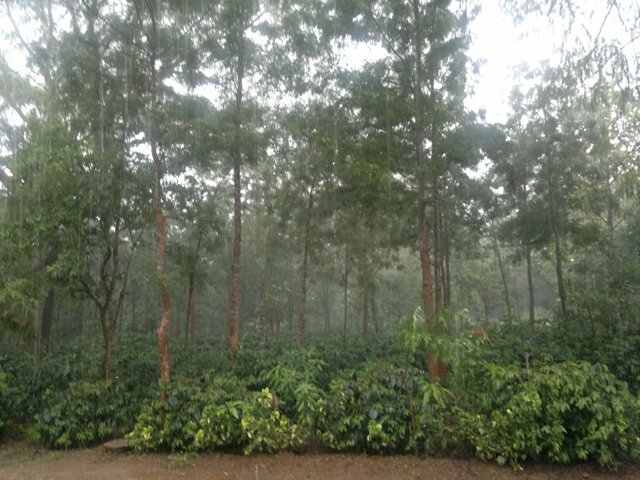

A coffee estate in Koraput under the afternoon rain.


Lychee in the orchard of Mr Pradhan bringing out some smiles

Following a hectic day at a tribal village and Mr Pradhan’s coffee estate we all retired back to Koraput. The following day we went on a journey along the Kolab reservoir with some extraordinary and unforgettable scenery along the way. With the Odisha Government allowing motor boats to take tourists on this trail, this is one journey which will be there in my memory for long and I must say that this lake along with beautiful deomali range and the pleasant weather makes Koraput the perfect hill station to explore.


 The Kolab reservoir (Lake) in Koraput.

During the boat trail at Kolab reservoir we also hopped into a stretch of land along the lake where a beautiful Aurobindo ashram is being built. As we walked up one of the hillocks we could see some ancient Jain statues lying in abandon which local tribals have mistaken as gods and goddesses.


Statues of ancient Jain tirthankars mistaken as gods and goddesses by tribals

After returning from Kolab reservoir we went on short trip to the tribal museum at Koarput which beautifully captures the rich tribal culture and tradition of Koraput. It was time for Gouthami to leave Koraput with some beautiful memories and I could only thank her for visiting Koraput and showing me the way to rediscover this place blessed with some extraordinary natural beauty. The next few days were equally interesting for me as I had set on a trail to meet some artisans with rare artistic talent. My first trip was to a village near Kotpad where the entire village is engaged in terracotta work and you need to visit it to see their skill. 


Terra cotta work by tribals of Koraput.

I followed it up with a trip to Nabarangpur where there are only few families left who are into a rare lac work with hundreds of years of history which is on the verge of extinction due to financial non viability. These are among some of the most beautiful handicrafts I have come across and it would be shame if we can’t save it.


Kalash made up of lac by artisans of Nabarangpur near Koraput


Lac box made by artisans of Nabargpur near Koraput which can be used as a jewellery box or a sweet box

Koraput is a strong amalgamation of natural beauty, art and culture. You have to visit Koraput to know. 

Some information about Koraput: The town of Koraput is around 3000ft above sea level situated in the southern part of Odisha. Nearest airport from Koraput is Vishakhapatnam and it takes roughly 4.5 hours by road from Vishakhapatnam to Koraput connected directly by national highway (NH43). You can reach there by train directly from Bhubaneswar, Vishakhapatnam and Kolkata.

Interested in visiting Koraput? You can reach the writer Kamakhya at kamakhya.das@gmail.com or for more information visit: www.koraput.nic.in


Thursday, 28 July 2011

Spiti Valley: 10 experiences that’ll take your breath away


SANYO DIGITAL CAMERA
Climb with me to the mountains on the roof of the world. I’ll walk you by gushing rivers. I’ll show you curious summits staring starry skies. I’ll float you to the depths of ancient seas. I’ll take you to the world’s highest inhabited villages. I’ll enchant you with blue streams in deep gorges.
Won’t you come with me on a journey through Spiti, the most breathtaking valley in the north of India?
1. Mountain ropeway at Chichum.
This is literally breath-taking. As an alternative to the long uphill walk from the village of Kibber to Chichum, the locals built an ingenious ropeway between two mountain peaks, over a deep gorge. The small open box on the pulley is used to transport men, cattle and raw materials, has no weight limits, and can’t be kind to your shoulders, though if you’re lucky, you’ll find someone on the other end to pull your ropes. The ropeway was built 5 years ago, and it has never yet collapsed.
This local engineering feat is worth a ride for the stunning views of the gorge below and the intimidating aura of the surrounding peaks.
Chichum, chichum ropeway, Spiti, spiti valley, things to do, attractions, himachal pradesh, offbeat travel, india
the cable car to Chichum village.
2. Dhankar Lake.
The 1.5 hour uphill trek from Dhankar Monastery along the Spiti River to the Dhankar Lake, affords some gorgeous views of the village below and the monastery in the distance. Dhankar Lake is a picture of serenity, peace and calm, and could make anyone feel introspective. Expect a clear expanse of water dotted with fish-generated ripples, a backdrop of snow-capped mountains, and herds of yak or yaks-bred-with-cows.
Dhankar lake, dhankar, spiti, spiti valley, offbeat travel, india, himachal pradesh
dhankar, dhankar lake, spiti, spiti valley, india, offbeat travel, rainbow, sun, sky
a rainbow makes a halo around the sun in the clear Dhankar sky.
3. Hike to Key gompa. 
It’s easy to rent a car or hitch-hike up to Key Monastery, but the real beauty is in hiking up from Key village, through the narrow, pebbly mountain path carved out by locals, and watching the monastery appear bit-by-bit, perched precariously atop a small hill.
Key monastery, Ki gompa, key village, spiti, buddhism, offbeat travel, india, himachal pradesh
4. Birdwatching at Langhza
You don’t have to be a bird-watcher or a biology-enthusiast to fall in love with the little village ofLanghza. It’s easy to forget about civilization on its isolated slopes, and all you need to do is look up at the clear blue skies for thrilling glimpses of hawks, eagles and vultures. You could spot these elusive birds in other parts of Spiti too, but the landscape of Langhza ups that thrill by a few notches.
Langhza, spiti valley, spiti, village, bird watching, hawk, himalayas, offbeat travel, india, himachal pradesh
a hawk flies high at Langhza.
5. Highest inhabited village in the Himalayas.
Imagine living at an altitude of 4,513 metres, in a neighborhood of 13 households, and a 6-hour hike away from the nearest signs of civilization. That’s life for you at Komic, the highest inhabited village of the Himalayas, and perhaps the world. Its landscape will leave you in awe.
Komic, Komik, village, Spiti, Spiti valley, highest village, Himalayas, offbeat travel, india, himachal pradesh
6. Full moon by the Spiti River. 
Ditch the bustling market of Kaza (Spiti’s capital), walk along the dry river bed that separates old Kaza from new Kaza, and make your way down to the Spiti River. You can feel its intensity only at its shore; mountain perspectives are such that from an altitude, water merely appears to trickle in the river. Sunset is not a specialty here, because the setting sun hides behind the mountains, leaving the sky a pink-red-orange color. A full moon at the shore, on the other hand, is bound to make your night and tease you with mountain shadows and water reflections. Concentrate on the sky, and you’ll see atleast a dozen shooting stars too.
Spiti river, spiti valley, spiti, moonlight, full moon, night, offbeat travel, india, himachal pradesh
 7. Pin valley
Pin Valley is an oasis of green in the cold mountain desert region. After being surrounded by the brown bareness of the Himalayas in Spiti, Pin Valley is a breath of fresh air that you didn’t know you missed; think trees and waterfalls. And if you think Spitians are friendly, get ready to be blown away by the hospitality of the mountain folks living in Pin Valley. You’ll leave convinced that this was how we were intended to lead life on earth.
Pin valley, Spiti, spiti valley, guling, offbeat travel, india, himachal pradesh
8. The mummy of Giu.
Spiti is full of legends, and the mummy of Giu is perhaps the only one that you can testify to. It is said that during a drought in Tibet, several lamas were mummified. During the Chinese occupation of Tibet, most of these mummies were destroyed. However, in the earthquake of 1975, one of these mummies washed up in the Spiti River and was rescued by the Indian government. It was housed in Giu, where during a digging accident, a spade hit the mummy’s head and it started to bleed! You can still see hair growing on the mummy’s head, and spooky as it might sound, it is one of those things you have to see to believe.
Giu, mummy, lama, Spiti, spiti valley, offbeat travel, india, himachal pradesh
the new temple built for the mummy of Giu. Photo credit: Richard Weil.
9. The world’s highest post office & petrol pump.
It’s not easy to build a life at 4,000 metres. In fact, Spiti is recognized for having the world’s highest post office at Hikkim, and the world’s highest petrol pump at Kaza. Surely, using them is a worthwhile travel achievement to boast about!
hikkim, highest post office, Spiti valley, Spiti, offbeat travel, india, himachal pradesh
highest post office in the world, at Hikkim.
10) Fukchung, a nuns-only village.
Spiti is known for some of the oldest monasteries and schools of Tibetan Buddhism. Fukchung village is a collection of stone caves, where nuns from the Nyingmapa school of Buddhism go for long-term retreats. They typically spend 3 years in a stone cave, meditating from morning to night, and not seeing or speaking to a human soul. It’s an intense experience, to walk along the caves, imagining the conviction of the nuns meditating inside them.
Fukchung village, Spiti, Spiti valley, nuns only village, nuns retreat, Buddhism, offbeat travel, India, himachal pradesh
a stone cave at Fukchung, where a nun has been in retreat since November 

Monday, 18 July 2011

The Visitor in Seoni

Suchi from http://womaninterrupted-merablog.blogspot.com just got back from a trip to a farm in Seoni, Madhya Pradesh along with Gouthami... as usual, an action packed visit, here's her interesting update:


So much to share, but first the story I am simply bursting to tell!! It just has to be told quickly you see, otherwise it'll lose its sting...

It was the first time that I stayed at the farm during the rains. And I guess just as the monsoons are the peak season for tourism in the places around Mumbai – with hordes of people making their way to Lonavala, Khandala and the likes, it was peak tourist season at our farm in Bhatiwara too.

For the fauna of Seoni, that is.

Our friend Gouthami was coming over to the farm for a couple of days, and I had decided to join her, having missed seeing the farm in all its glory during the last monsoons.(Here is a pic from last year for ref)


Well, we didn't get to see the butterfly colonies this time (probably a little early for them), but we did have a whole lot of other visitors peeping into the mud hut Gouthami and I were sharing. There was a rather frisky centipede, a large number of fat black ants, a frog so small that at first I thought it was a cricket, and at a rough estimate, about 126 earthworms - all crawling, creeping or hopping right into our room. To have a dekko at us, from the looks of it.

But the most important visitor of all was a large scorpion, making its way rather grandiosely from a corner to the centre of our room, when we spotted it… I, of course, made absolutely no pretensions of bravery and scampered right out of the room with a loud yell. Gouthami, being made of stronger stuff, maintained her decorum and ambled out in a more dignified manner.

A young lad, the son of one of the farm-hands, volunteered to get the scorpion out of our room. As soon as he could stop rolling on the floor with laughter on seeing our reaction to the scorpion, that is.

Room de-scorpioned (by the brave lad carrying it out on a stick), we tried to go to sleep… I chose the ‘samadhi’ option – covering myself entirely from head to toe with a thick quilt, even though it was rather warm – in the hope that no creepy-crawly would be able to make its way inside the samadhi. My nervousness was contagious, but Gouthami tried to shake it off by declaring (in a tone that I think was supposed to be reassuring), “Scorpions stings don’t kill, you know - they are just extremely, extremely painful.”

Not the least bit reassured, I continued in my samadhified state – coming up for air occasionally, and not getting a wink of sleep, naturally.

Needless to say, all the locals were totally unfazed by the incident. All these creatures are very much a part of their lives. Even as we became extra wary after the sighting, shining the flashlight on the floor to check it carefully before stepping down from our cots at night, these people continued sitting around on the floor in their huts, chatting merrily. The sighting was an absolute non-incident for them!

By the next morning, things were back to normal even for us– with Gouthami rueing the fact that she did not think quickly enough to get some nifty close-ups of the regal creature before dashing out of the room, and both of us fondly remembering Nissim Ezekiel’s classic, ‘The Night of the Scorpion’.

Whatever else, the night visitor gave me a good opportunity to tell stories and boast about the sighting to all those who cared to listen. Gouthami tried to dampen my spirited story-telling, by raising one eyebrow and asking, “How big, how big?!” with a highly skeptical air every time I said “The scorpion was THIS big..’’ and displayed its size to the audience...

Tch! Some people just don't believe in artistic license. :-/


"I saw a human being last evening - she was THIS big... and yellow......."


Anyway, it was a rare encounter, and I am not going to miss any opportunity in future to tell this story... exaggerations and all. And I guess the scorpion is not likely to forget it either - the day a 1.7 m tall human being turned pale at its sight, and scooted at top speed...

- Suchi Srinivas